
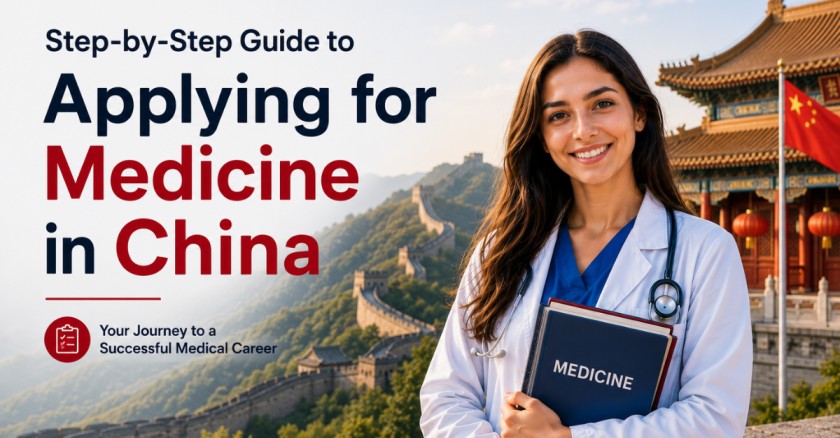
Step-by-Step Guide to Applying for Medicine in China (2026 Complete Guide)
China has emerged as one of the world’s leading destinations for international medical education. With internationally recognized universities, affordable tuition fees, modern teaching hospitals, and English-taught MBBS programs, China attracts thousands of aspiring doctors from Asia, Africa, the Middle East, and beyond every year.
Chinese medical universities are recognized by the World Health Organization (WHO) and listed in the World Directory of Medical Schools (WDOMS), allowing graduates to pursue medical licensure in many countries after meeting local requirements.
This comprehensive guide explains everything you need to know about applying for medicine in China, from selecting a university to obtaining a visa and starting your studies.
Why Study Medicine in China?
China offers world-class medical education with advanced infrastructure and extensive clinical training opportunities.
Key Benefits
- English-taught MBBS programs
- Globally recognized degrees
- Affordable tuition fees compared to Western countries
- Modern hospitals and laboratories
- Strong research opportunities
- Diverse international student communities
- Scholarships for international students
- Rich cultural experience and rapidly developing healthcare sector
Step 1: Understand the Structure of Medical Education in China
Medicine in China is typically offered as a six-year MBBS program, including one year of internship.
Students can enroll directly after high school.
Years 1–2: Basic Sciences
Subjects include:
- Anatomy
- Physiology
- Histology
- Biochemistry
- Medical Biology
Years 3–5: Clinical Sciences
Students study:
- Pathology
- Pharmacology
- Internal Medicine
- Surgery
- Pediatrics
- Obstetrics and Gynecology
- Psychiatry
Year 6: Internship
Students undergo clinical rotations in teaching hospitals. Graduates receive:
Bachelor of Medicine and Bachelor of Surgery (MBBS)
Step 2: Check Eligibility Requirements
Applicants generally need:
- Completion of 12 years of education
- High school diploma or equivalent
- Biology, Chemistry, and Physics background
- Good academic standing
Typical Requirements
| Qualification | Recommended Requirement |
| A Levels | Biology, Chemistry preferred |
| CBSE/ISC | 60–70% or above |
| IB Diploma | Accepted |
| WAEC | Accepted |
| GCSE/O Levels | With higher secondary qualifications |
Age Requirement
Most universities require applicants to be:
17–25 years old
Step 3: Choose a Medical University
China has more than 40 universities approved to teach MBBS in English.
Top Medical Universities in China (2026)
| Rank | University | City |
| 1 | Peking University Health Science Center | Beijing |
| 2 | Fudan University | Shanghai |
| 3 | Shanghai Jiao Tong University | Shanghai |
| 4. | Zhejiang University. | Hangzhou |
| 5 | Sun Yat-sen University | Guangzhou |
| 6 | Sichuan University | Chengdu |
| 7 | Wuhan University | Wuhan |
| 8 | Nanjing Medical University | Nanjing |
| 9 | China Medical University | Shenyang |
| 10 | Jilin University | Changchun |
Peking University Health Science Center
China’s most prestigious medical institution.
Strengths
- Exceptional research output
- World-class hospitals
- Strong international reputation
Fudan University
One of China’s highest-ranked universities.
Strengths
- International partnerships
- Advanced research facilities
- Excellent clinical training
Shanghai Jiao Tong University School of Medicine
Known for innovation and medical excellence.
Zhejiang University School of Medicine
Among Asia’s leading medical schools.
Step 4: Understand the Admission Process
Unlike Italy, China generally does not require a national entrance examination for international students.
Admission is primarily based on:
- Academic records
- Biology and Chemistry performance
- Document verification
- English proficiency
Some universities may conduct online interviews.
Step 5: Prepare Required Documents
Applicants typically need:
Academic Documents
- High school certificate
- Academic transcripts
- Passport copy
Additional Documents
- Passport photographs
- Physical examination form
- Personal statement
- Recommendation letters (for some universities)
- Police clearance certificate Documents may require:
- Notarization
- Apostille
- Certified translations
Step 6: Submit Applications
Applications can be submitted:
Directly to Universities
or
Through Authorized Admission Offices,
Main Intake
September
Applications are usually open between:
December and June
Applying early is strongly recommended.
Step 7: Attend Interview (If Required)
Some universities conduct online interviews. Questions may include:
- Why do you want to study medicine?
- Why China?
- Tell us about yourself.
- Explain basic biological concepts.
- Describe your career goals.
Step 8: Receive Admission Letter
Successful students receive:
- Admission Notice
- Tuition Invoice
- JW202/JW201 Form (Visa Application Form for Foreign Students) These documents are required for visa applications.
Step 9: Apply for an X1 Student Visa
International students pursuing long-term studies require an:
X1 Student Visa
Required documents include:
- Passport
- Admission Notice
- JW202/JW201 Form
- Medical examination report
- Visa application form
- Passport photographs Processing generally takes: 2–6 weeks
Step 10: Arrange Accommodation
Students can choose:
University Dormitories
Advantages:
- Affordable
- Safe
- Convenient
Shared Apartments
Popular among senior students.
Private Housing
Provides more privacy.
Average Monthly Costs
| City | Monthly Cost |
| Beijing | $500–900 |
| Shanghai | $600–1,000 |
| Guangzhou | $350–700 |
| Chengdu | $300–600 |
| Wuhan | $250–500 |
Step 11: Understand Tuition Fees
China remains highly affordable compared to Western countries.
Annual Tuition Fees
| University. | Tuition Fee. |
| Peking University | $7,000–9,000 |
| Fudan University | $8,000–10,000 |
| Shanghai Jiao Tong University | $8,000–10,000 |
| Zhejiang University | $7,000–9,000 |
| Wuhan University | $5,000–7,000 |
| China Medical University | $5,000–7,000 |
Additional expenses include:
- Registration fees
- Health insurance
- Books and materials
Scholarships Available
Chinese Government Scholarship (CSC)
One of the most prestigious scholarships for international students. Benefits include:
- Full tuition waiver
- Accommodation support
- Monthly stipend
- Medical insurance
Provincial Government Scholarships
Offered by many Chinese provinces.
University Scholarships
Merit-based financial aid available at numerous institutions.
Cost of Living in China
China offers relatively affordable living expenses.
| Expense | Annual Cost |
| Tuition Fees | $5,000–10,000 |
| Accommodation | $3,000–8,000 |
| Food | $1,800–3,000 |
| Transportation | $300–600 |
| Miscellaneous | $1,000–2,000 |
| Total | $12,000–23,000 |
Recognition of Chinese Medical Degrees
Medical universities approved for international MBBS programs are listed in:
- World Directory of Medical Schools (WDOMS)
- WHO-recognized databases
Graduates can pursue licensing pathways including:
- USMLE (USA)
- UKMLA (United Kingdom)
- AMC (Australia)
- MCCQE (Canada)
- Gulf medical licensing exams
- FMGE/NExT (India)
Students should always verify licensing requirements in their intended country of practice.
Career Opportunities After Graduation
Graduates may:
Pursue Residency Training
Specialize in:
- Cardiology
- Orthopedics
- Dermatology
- Pediatrics
- Radiology
- Neurology
Prepare for International Licensing Exams
Such as:
- USMLE
- UKMLA
- AMC
- MCCQE
Enter Medical Research
Fields include:
- Biomedical Sciences
- Public Health
- Clinical Research
- Medical Education
Application Timeline
October-December
- Research universities
- Compare tuition fees and rankings
January-March
- Prepare documents
February-May
- Submit applications
April-June
- Attend interviews (if required)
May-July
- Receive admission letters
June-August
- Apply for visa
September
- Travel and begin studies
Application Timeline at a Glance
| Month | Activity |
| October-December | University research |
| January-March | Document preparation |
| February-May | Applications |
| April-June | Interviews |
| May-July | Admission offers |
| June-August | Visa process |
| September | Begin studies |
Top Medical Universities in China (2026)
| China Rank | University | City | Approximate Annual Tuition |
| 1 | Peking University Health Science Center | Beijing | $7,000–9,000 |
| 2 | Fudan University | Shanghai | $8,000–10,000 |
| 3 | Shanghai Jiao Tong University | Shanghai | $8,000–10,000 |
| 4 | Zhejiang University | Hangzhou | $7,000–9,000 |
| 5 | Sun Yat-sen University | Guangzhou | $6,000–8,000 |
| 6 | Sichuan University | Chengdu | $5,000–7,000 |
| 7 | Wuhan University | Wuhan | $5,000–7,000 |
| 8 | Nanjing Medical University | Nanjing | $5,000–7,000 |
| 9 | China Medical University | Shenyang | $5,000–7,000 |
| 10 | Jilin University | Changchun | $5,000–7,000 |
Final Thoughts
China has established itself as one of the most accessible and affordable destinations for international medical education. With globally recognized universities, English-medium MBBS programs, generous scholarship opportunities, and modern healthcare infrastructure, it provides an excellent pathway for aspiring doctors.
By planning ahead, applying early, and choosing a recognized university, students can gain access to quality medical education and open doors to medical careers across the world.