
SRH Berlin University of Applied Sciences, Berlin, Germany
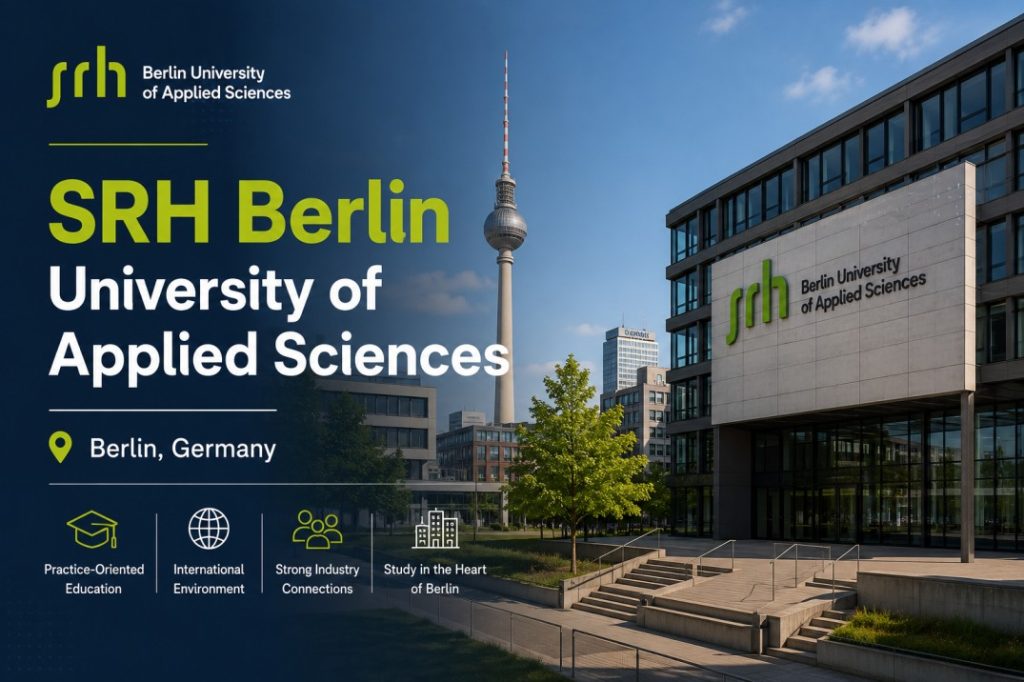
SRH Berlin University of Applied Sciences is one of Germany’s well-known private universities focused on practical, industry-oriented education. Located in Berlin, one of Europe’s largest startup and creative hubs, the university attracts a highly international student population seeking English-taught programs in business, technology, media, design, engineering, and management.
Founded in 2002, SRH Berlin has positioned itself as a modern university emphasizing employability, project-based learning, and global exposure. Unlike Germany’s traditional research-heavy public universities, SRH follows the “University of Applied Sciences” model, where education is designed to align closely with industry demands and professional careers.
For international students, especially from India, the Middle East, and Africa, SRH Berlin has become a visible name due to:
- English-taught programs
- Easier admission process compared to public universities
- Berlin location advantage
- International classroom environment
- Flexible academic pathways
However, the university also receives criticism regarding tuition costs, employer reputation within Germany, and comparisons with public universities. Understanding both the strengths and limitations of SRH Berlin is essential before applying.
History and Institutional Background
SRH Berlin University of Applied Sciences was established in 2002 and later became part of the larger SRH Holding education group in Germany. Over time, the institution expanded through mergers with several design, communication, and management schools across Berlin and Dresden.
The university evolved into a multi-school institution specializing in:
- Business and Management
- Technology and Engineering
- Creative Industries
- Media and Communication
- Music and Arts
- Hospitality and Tourism
In 2024, SRH Berlin underwent organizational restructuring and became integrated into the larger SRH University network headquartered in Heidelberg.
Despite these structural changes, the Berlin campus remains one of the most internationally visible branches within the SRH system.
Campus and Location Advantage
One of SRH Berlin’s strongest selling points is its location.
Berlin is often considered Europe’s startup capital and one of the continent’s most multicultural student cities. The city offers:
- Growing tech industry
- Startup ecosystem
- Creative economy
- International work opportunities
- Strong public transportation
- Diverse student population
Students studying at SRH Berlin gain exposure to companies and industries connected to:
- Artificial Intelligence
- UX/UI Design
- Marketing
- Music and Media
- Engineering
- FinTech
- Sustainability
The university recently consolidated many of its operations into a modern campus in Berlin-Neukölln.
Academic Programs
SRH Berlin offers Bachelor’s, Master’s, and MBA programs in both English and German.
Popular Fields of Study
Business and Management
- International Business Administration
- Entrepreneurship
- International Management
- MBA Programs
Technology and Engineering
- Computer Science
- Cybersecurity
- Big Data & AI
- Software Engineering
- Sustainable Technology Management
Creative and Media Fields
- UX Design
- Communication Design
- Film & Motion Design
- Music Production
- Photography
- Creative Industries Management
Hospitality and Tourism
- Hospitality Management
- Global Hospitality Leadership
Many of these programs are specifically designed for international students.
Teaching Style and Learning Model
SRH Berlin strongly promotes project-based and practical learning.
According to university descriptions, students frequently work on:
- Real company projects
- Industry collaborations
- Group-based assignments
- Case studies
- Internship-integrated coursework
The university collaborates with companies such as:
- Audi
- Lufthansa
- Coca-Cola
- Red Bull
These partnerships are intended to improve employability and practical experience.
Unlike Germany’s traditional universities that focus heavily on theoretical research, SRH Berlin emphasizes:
- Small classroom interaction
- Industry preparation
- Applied knowledge
- Portfolio-building
This model appeals particularly to students interested in media, design, business, and creative careers.
International Student Population
SRH Berlin markets itself heavily as an international university.
According to university-related sources:
- Students from over 85 countries study there
- International students form a large percentage of enrollment
- Many courses are fully English-taught
This creates a multicultural environment where international students often feel more comfortable compared to public German universities that operate mainly in German.
For many students, especially those unfamiliar with Germany’s language system, SRH offers:
- Easier transition
- English-speaking environment
- Visa support
- International admissions guidance
Admission Process
Compared to public German universities, SRH Berlin generally has:
- Higher acceptance rates
- Simpler admission procedures
- Faster application processing
Estimated acceptance rates range around 50–55%.
Common admission requirements include:
- High school diploma for Bachelor’s
- Relevant Bachelor’s degree for Master’s
- English proficiency tests such as IELTS or TOEFL
- Motivation letter
- Portfolio for creative courses
For international students, this accessibility is often one of the university’s biggest attractions.
Tuition Fees and Living Costs
Since SRH Berlin is a private university, tuition fees are significantly higher than public German universities.
Estimated Tuition Fees
- Approximately €8,000–€15,000 annually depending on the program
Living Costs in Berlin
Students typically spend:
- €800–€1,400 monthly on:
○ Accommodation
○ Food
○ Insurance
○ Transport
○ Personal expenses
Berlin remains cheaper than cities like London or Paris, but housing shortages have made accommodation increasingly expensive for students.
Rankings and Reputation
SRH Berlin does not rank among Germany’s top research universities.
Different ranking platforms place the institution lower compared to public universities such as:
- Technical University of Munich
- Humboldt University of Berlin
- Technical University of Berlin
Approximate rankings include:
- Global rankings around 3000–6000 depending on ranking systems
However, ranking alone does not fully reflect SRH’s positioning because the university focuses more on:
- Applied education
- Career preparation
- Industry collaboration
rather than large-scale research output.
Student Reviews and Criticism
SRH Berlin receives mixed opinions online.
Positive Feedback
Students often praise:
- International environment
- English-speaking atmosphere
- Creative programs
- Industry-oriented teaching
- Berlin lifestyle
- Smaller class sizes
Some students particularly appreciate:
- Networking opportunities
- Startup culture exposure
- Flexibility for international learners
Common Criticisms
A major criticism revolves around tuition value versus reputation.
On Reddit and German student forums, several users describe concerns regarding:
- High tuition fees
- Weak reputation compared to public universities
- Administrative issues
- Inconsistent teaching quality
- Limited employer recognition in Germany
Some German students argue that public universities are academically stronger while being almost tuition-free.
However, opinions vary significantly depending on:
- Specific program
- Campus
- Faculty
- Student expectations
- Career goals
Creative and applied programs tend to receive relatively better feedback than purely academic programs.
Career Opportunities After Graduation
Germany allows international graduates to stay after completing studies to search for jobs, making SRH Berlin attractive for students seeking European work opportunities.
Graduates commonly pursue careers in:
- Marketing
- UX/UI Design
- Software Development
- Data Analytics
- Media Production
- Hospitality
- International Business
Berlin itself offers opportunities through:
- Startups
- Creative agencies
- Tech companies
- Freelance industries
However, career outcomes depend heavily on:
- German language skills
- Internships
- Networking
- Portfolio quality
- Individual initiative
Students without German proficiency may face limitations in certain sectors.
Is SRH Berlin Worth It?
The answer depends on the student’s priorities.
SRH Berlin May Be Suitable If:
- You want English-taught education in Germany
- You prefer practical learning over theory
- You are interested in creative or applied industries
- You value international exposure
- You can financially afford private tuition
It May Not Be Ideal If:
- You want elite research prestige
- You seek low-cost education
- You prioritize traditional academic reputation
- You expect guaranteed employment solely from university branding
For many international students, SRH acts as an accessible gateway into Germany’s education system and job market. But students should carefully compare it with public universities before making a decision.
Conclusion
SRH Berlin University of Applied Sciences represents a modern, internationally focused approach to higher education in Germany. With its emphasis on applied learning, industry projects, and English-taught programs, the university has become particularly attractive to international students seeking career-oriented education in Europe.
Its greatest strengths lie in:
- Berlin location
- International diversity
- Practical learning methods
- Creative and business-focused programs
At the same time, prospective students must realistically evaluate:
- High tuition costs
- Competitive German job market
- Reputation differences compared to public universities
Ultimately, SRH Berlin can provide strong opportunities for motivated students who actively build skills, networks, internships, and language proficiency during their studies. Success at the university often depends less on the institution’s ranking and more on how effectively students use Berlin’s dynamic professional ecosystem to shape their careers.